
Road to Omaha
How Does the NCAA Baseball Tournament Work? Regionals to Omaha Explained
By Baseball Schedule Editorial Team · Published · Updated
The NCAA Division I baseball tournament becomes much easier to follow once you stop treating every round as the same kind of competition. A regional is not a super regional, and reaching Omaha is not the same as reaching the championship series. Each stage asks teams to advance through a different structure.
For a new fan, the names can make a straightforward idea feel unnecessarily complicated. The tournament begins with a national field, narrows through regional and super regional play, and ends with the Men's College World Series in Omaha. The important practical question is what a team must do to remain alive at each point.
This guide explains the format in plain language and then connects it to the questions fans actually ask: which games are necessary, why some teams get another chance after a loss, and how to plan tickets or viewing when later matchups depend on earlier results. Always use the current official bracket for the actual season's assignments.
The championship is bigger than Omaha
The phrase College World Series is sometimes used loosely for the entire postseason, but Omaha is the final stage rather than the starting point. A team must first advance through earlier rounds. Recognizing that distinction helps you understand why a regional weekend can be so important even though it happens far from Nebraska.
It also explains why teams can have successful seasons without appearing in Omaha. The championship path requires a sequence of performances against postseason opponents, and the earlier rounds have their own pressures and stories. The final destination should not erase what happens before it.
When reading a schedule, look for the round as well as the date. A page labeled regional, super regional, or Men's College World Series is describing a particular part of the championship. That label tells you which format to apply to the results.
Selection creates the starting field
The Division I tournament uses a 64-team field. Teams enter through automatic qualification and at-large selection under the championship's current procedures. The exact season's selection information should come from the NCAA rather than an outdated breakdown copied from another year.
A prediction published before selection day is not an official bracket. Projections can be useful for discussing possibilities, but they remain forecasts. Wait for the official announcement before treating a destination, opponent, or hosting assignment as confirmed.
This distinction matters for travel. A fan who books around a projected regional may end up with the wrong city or a matchup that never materializes. If you choose to plan early, understand that you are accepting uncertainty rather than acting on a settled assignment.
Regionals put four teams together
The 64 teams are divided into 16 regional brackets, each containing four teams. Regionals use double elimination, so the first loss does not automatically end a team's tournament. The bracket tracks both the results and the route each team must take afterward.
That structure is why a regional can feel different from a normal weekend series. You are not simply watching the same two teams play three scheduled games. Opponents and later game assignments depend on who wins and loses along the way.
Keep the official bracket visible while following a regional. A score list alone can tell you what happened without showing what it means for the next contest. The bracket answers the more useful questions: who plays next, who is still alive, and what conditions could create another game.
Double elimination changes how you interpret a loss
A team with one loss can remain in a double-elimination bracket, but its path becomes less forgiving. It may need to play additional games or defeat an opponent that has not yet lost. That can affect pitching availability and the rhythm of the weekend.
For a fan, the practical lesson is not to assume elimination from one disappointing result. Check the bracket and the team's next assignment. Equally, do not assume a team is safe simply because it won its opener. Advancement still requires completing the bracket.
If a final game is labeled conditional or if necessary, read the condition rather than treating the listing as a guaranteed appointment. The schedule is representing a possible route through the format. Whether that route is needed depends on the results already played.
Super regionals are best-of-three series
The 16 regional winners move into eight super regional matchups. Each is a best-of-three series between two teams. Win two games and advance; lose two and the season ends. That objective is simpler to follow than a four-team bracket.
The first game matters, but it does not settle the series by itself. A team can lose the opener and still advance by winning the next two. Conversely, a team that wins the first game still needs another victory rather than merely a strong performance or a favorable run margin.
This is where the label if necessary becomes especially easy to understand. A third game is needed only when the teams split the first two. If you are planning to attend or watch, leave room for either a two-game finish or a deciding third contest.
Eight teams reach Omaha
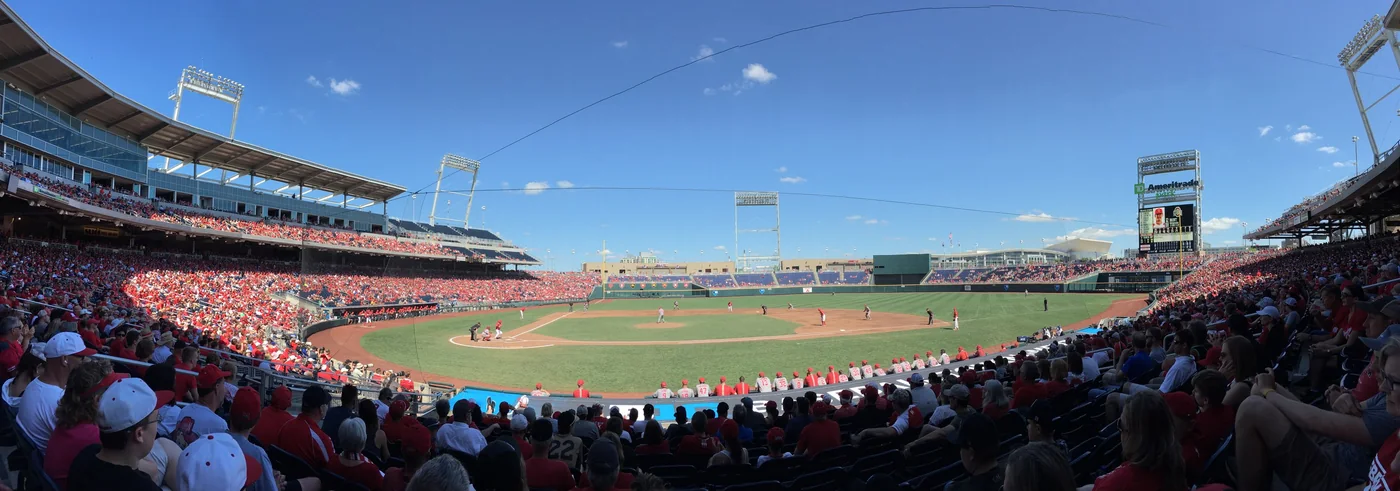
The eight super regional winners advance to the Men's College World Series. Omaha begins with two four-team double-elimination brackets. Each bracket produces a winner, and those two winners meet in the championship series.
Do not carry the super regional's best-of-three logic into the start of Omaha. The opening phase is bracket play again, which means the effect of a loss depends on the team's place in that bracket. The official diagram remains the easiest way to keep the path straight.
For someone attending several sessions, this creates an enjoyable variety of possible matchups. It also creates uncertainty if the entire trip depends on seeing one particular school. Our Omaha planning guide explains how to account for that uncertainty before booking.
The championship series decides the title
The two Omaha bracket winners play a best-of-three championship series. The national champion is the first team to win two games in that series. The route to this point is complicated; the final objective is not.
A strong performance in an earlier round does not carry a numerical advantage into the final series. Those earlier results explain how the teams arrived, but the championship games decide the title. Follow the current series score rather than combining results from unrelated stages.
If you want to watch the champion crowned, account for the possibility of a third game. A booking that covers only the first two championship dates may be perfectly sensible for your budget, but it should be a conscious choice rather than an overlooked condition.
Why pitching depth becomes a major storyline
The format creates different demands at different stages. A team taking a longer route through a regional may need more innings from more pitchers than a team advancing efficiently. That is one reason postseason discussion often focuses on available arms rather than only on the season's most recognizable starter.
Super regionals concentrate attention on a two-team series, while Omaha's bracket phase can again create several possible paths. Coaches must make decisions with both the immediate game and potential later games in mind. Fans do not need to know every pitching role to understand why those choices matter.
Be careful, though, about treating an assumed rotation as a confirmed announcement. Use current team notes and official pregame information. A familiar starter's usual day during the regular season does not guarantee the same assignment after weather changes or a demanding postseason game.
How to read a bracket without getting lost
Find your team, identify its next game number, and trace both possible outcomes from that point. Ask what happens after a win and what happens after a loss. Doing this one step at a time is easier than trying to memorize the entire national bracket at once.
Keep the date and venue beside the game number. As the tournament moves between rounds, similar team names and repeated opponents can create confusion in search results. A replay or an old box score may look current if you do not check those details.
When sharing information, link the official bracket rather than sending only a cropped screenshot. A screenshot is convenient, but it becomes stale after the next result. The official page gives friends a way to see the updated path for themselves.
Turn the format into a better viewing plan
Choose which regional or series you want to follow, then confirm the broadcast assignment for each game. Postseason coverage can differ from the regular-season arrangements you already know. A familiar team does not necessarily mean a familiar streaming requirement.
Build flexibility around conditional games. You can mark them as possible events in your calendar rather than pretending the schedule is fixed. If a game becomes unnecessary, remove the reminder; if it becomes decisive, you will already have time reserved.
The tournament is easier to enjoy when you understand both its rules and its uncertainty. You do not need to predict every outcome. Knowing what the next result means is enough to follow the drama as it develops.
Official format references
Use the NCAA's explanation of the Men's College World Series and the current official championship bracket. Our team pages and schedule directory provide the regular-season context, while the NCAA's bracket supplies the postseason path.